
4: Morocco's Famous Green Ceramics
Updated: Jan 31

Erg Chebbi - and the Auberge campsite in particular is such a special place we don't understand why it isn't busier. There are a few other vans here but we and Bernd are by ourselves in prime position.

The dogs like it too!

Last time we were here we didn't explore the small town of Merzouga and it seems a shame not to visit it this time, so out come the bikes and off we set.

There are a couple of tourist shops here but it's a very soft sell. We wander the main street browsing.....
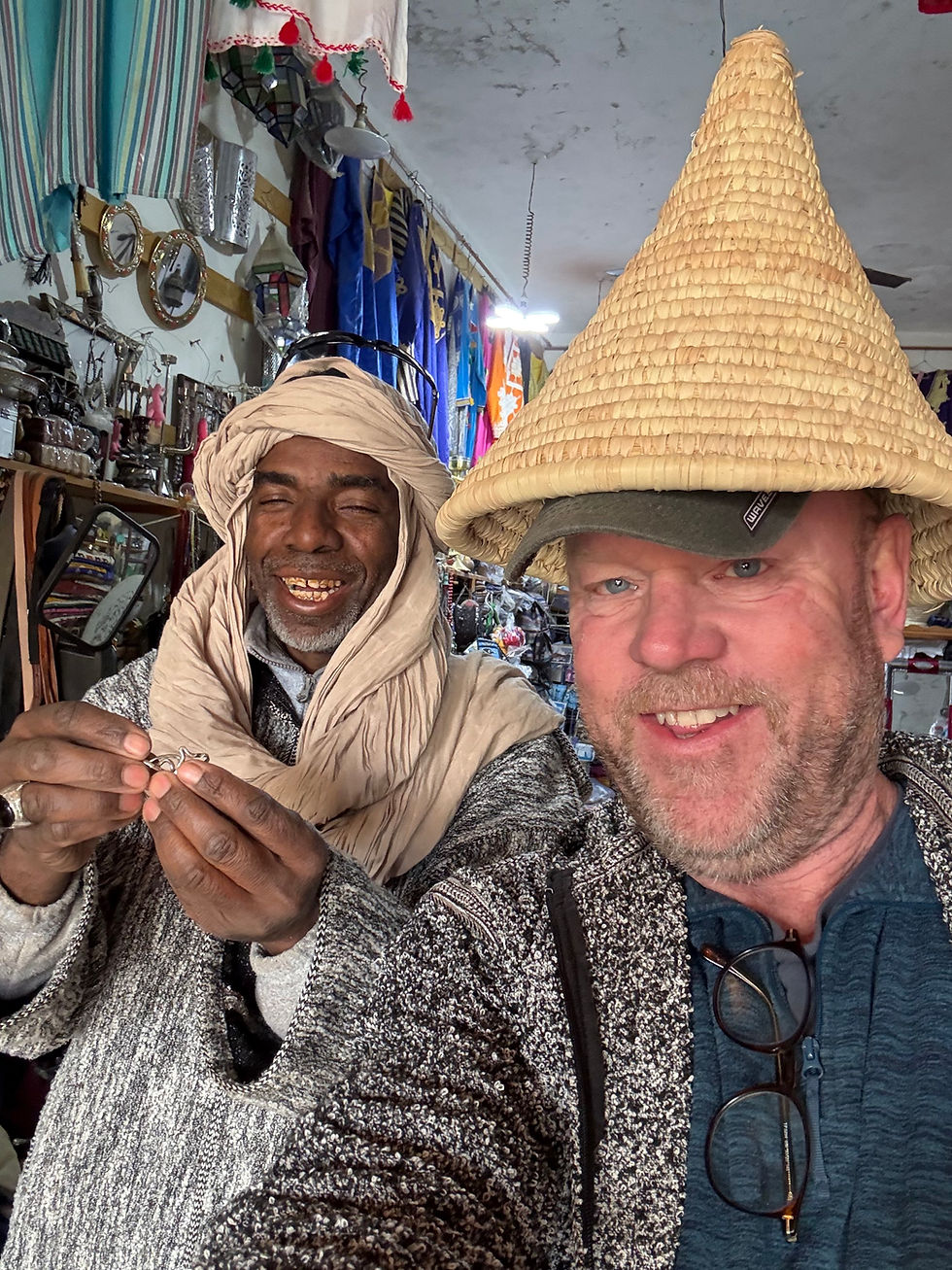
.....Nick challenges the shop keeper to put together his Indian puzzle ring - while assessing another potential fashion trend in head gear! Thankfully he doesn't make a purchase!

We take the opportunity to stock up on some spices and we have a good chat with the shopkeeper who advises us on the best mix for cooking a traditional tagine.

He also does a good range in bottom enhancing creams but Janette feels she's amply provided for in this department already.

It's time to be on our way this morning and Mubarak asks whether we would give him a lift to his home town of Rissani, not far away. Mubarak's wife and six children live there as does he when he's not working at the Auberge. Mubarak says he will take us to a traditional Bereber house.
The 'house' turns out to be an Aladdin's Cave containing all sorts of artefacts ready and waiting for us to view - and the owner hopes to buy!
We do actually want a rug and we measured up before we left home. We drive Ali round the bend as each rug he shows us is either not the right size, not the right colour or not the right style.
Undaunted, Ali perseveres and eventually - about 40 rugs in, we find not one but two rugs that fit the bill… and the bargaining begins. After much toing, froing and tooth sucking we reach a price that we're all happy with and the deal is done.

We leave Rissani just as the rain (the first rain we've seen in Morocco on either trip) sets in and it continues for most of the 2 hour drive.

As we approach our destination, the weather clears and a stunning mountain range reveals itself. We are headed for a campsite that is out on its own in the middle of nowhere and the last section of the journey sees us leaving the tarmac and heading off on an unmade track.

The scenery here is remarkably similar to that in the sub-Saharan African countries we visited last year, we keep expecting to see elephants wandering about!

This campsite is really great, it is remote and peaceful; it's family owned and run and the welcome is warm. There's even a restaurant and we enjoy a delicious tagine for dinner.

We're back in fossil country and there are thousands and thousands of fossils and crystals for sale by the roadside.

The campsite owner shows us a path towards some mountains where fossils are found. We enthusiastically head off with Millie and Pip to try our hands at fossil hunting - with absolutely no success whatsoever!

We briefly visit the small town of Agdz and stop for lunch but there's not much there to hold us and we head on to our next rendezvous with Bernd in the village of Tamegroute, not far from Zagora.
Literally translated the name means 'final place before the desert' it was once a stopping place for the caravans on the ancient road to Timbuktu.

Although tiny, this place packs a big punch - it was once an important centre for Islamic learning and spiritual healing and was the seat of the Nassiri brotherhood, a Sufi movement of moderate Islam.
That would be enough to distinguish this tiny place but there's more - there is an ancient library, an underground village and a pottery producing green glazed items specific to this village.

We've read that it's nigh on impossible to explore this place without a guide and indeed there are plenty of candidates waiting to greet us as we arrive! We negotiate a price with Ali and set off.

The underground village is home to almost 2000 people (300 families).
It’s a maze of narrow passages and its pitch dark, we could never have managed to find our way alone.


We start to see evidence of the pottery industry in the shape of un-glazed pots.
The pottery making came into being in the 1600s when seven families from Fez settled here and today, these small scale businesses continue to be a family concern. The families have now formed themselves into a co-operative for the purposes of selling their products.

We emerge into the light in a large square and our jaws drop. This is an absolute hive of industry and it's like stepping back in time by hundreds of years.

The clay is collected from the Draa Riverbed by digging down sometimes as far as 10 metres . The clay is mixed with water and then spread out on the floor. The clay is then trodden underfoot and kneaded by hand to mix the clay and water thoroughly. When it is the correct consistency it is formed into large lumps.

These lumps are passed to potters who sit in holes up to their waists with a hand-powered wheel in front of them from which they produce a huge variety of items from tagine pots to candle sticks.
Once the items are formed they stand out in the sun until they are dry enough to be glazed. It is this glaze that makes the Tamegroute pots unique, it is a mixture of manganese, copper and silicon.

The kilns are a thing to behold. There are seven kilns - one for each family.

There is a fire pit below each kiln. Palm branches are fed in and the smoke billows out of the top of the kiln sometimes white, sometimes black and thick. When a kiln is filled with pottery it is sealed with clay and gradually the temperature rises to 1000 degrees.

We see the results when we visit the co-operative shop. It's a bit overwhelming as there is so much to choose from but we do buy a few bits. It is the copper in the glaze which results in the distinctive and traditional green colour.
Not all items are green, the mixture of the glaze is tweaked to produce other colours and finishes.
Honestly? This place had been really high on our list of places to visit and it is an amazing sight, but we felt our guide could have spent more time explaining what was going on and allowing us to linger in the ancient pottery area for longer. Instead it felt that we were just being whizzed through to the shop!
Our next stop is the library. Our elder daughter Juliet will be spitting black-eyed peas as ancient manuscripts are very much her thing - sorry sweetheart, we'll bring you here another time x

The library is situated in the Zaouia, an Islamic religious complex. These manuscripts are very precious and are all safely stored behind glass.

The librarian speaks good English and is very informative. Many of the manuscripts are beautifully decorated; they cover a diverse range of topics from mathematics to medicine to poetry, there are a number of dictionaries and of course, religious texts including a Koran written on gazelle hide and dating back to 11th century Cordoba!
Tomorrow we say goodbye to Bernd, as he needs to head back to Germany where he’s due to start building himself a new house… or perhaps the truth is that he’s had enough of doing our jigsaw puzzle?!?

It’s been great spending time with you Bernd - and we look forward to visiting your new home. Safe travels!


Wow! Particularly liked the first two photos, but what an adventure!